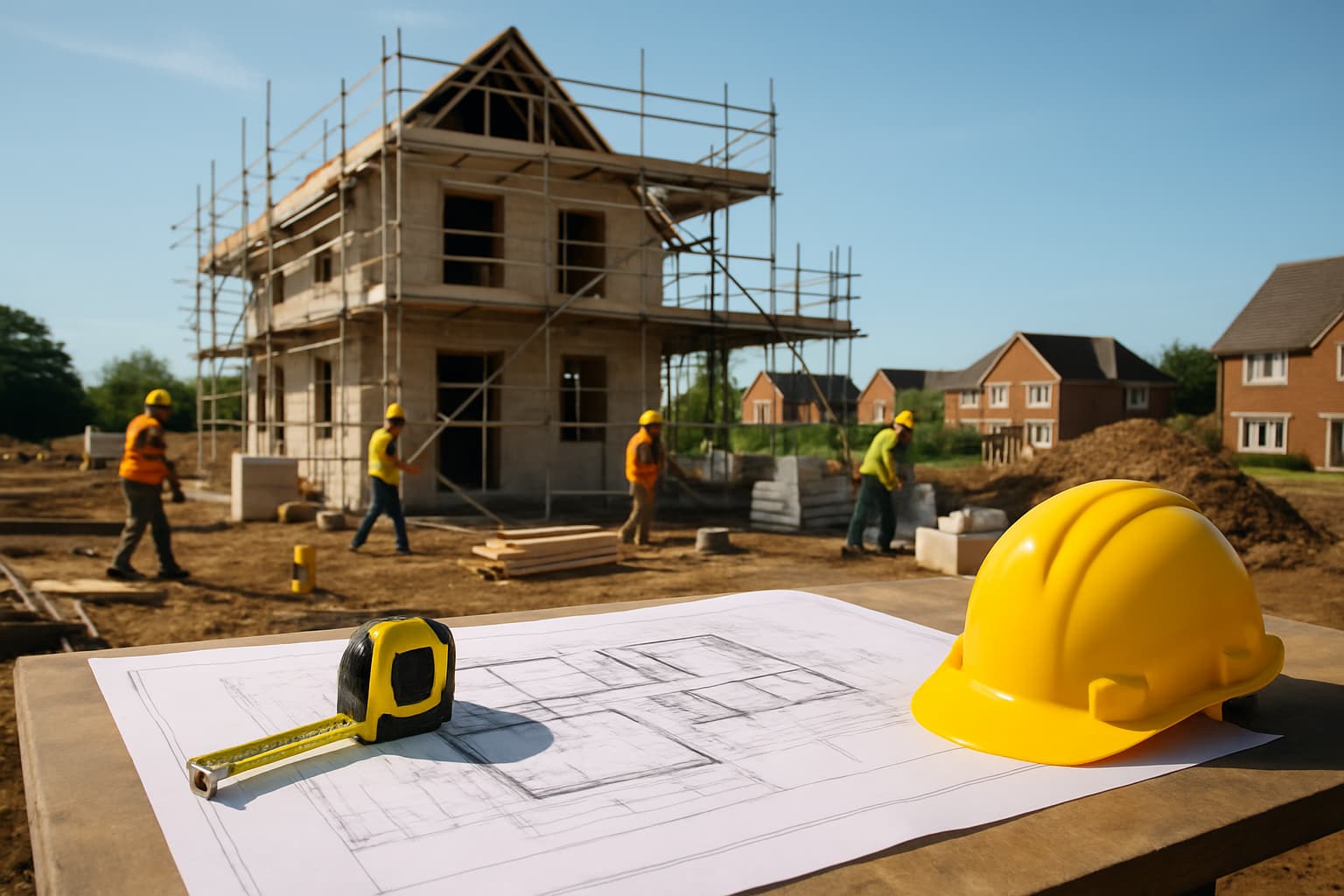
Horizontal vs. Vertical Financing: When to Use a Construction-to-Permanent Loan
Reviewed by Lisa Park, Compliance & Operations Director
Category: guide | Reviewed by Lisa Park, Compliance Manager
Every real estate developer eventually faces the same fork in the road: fund your project with a construction-only loan and refinance when it's done, or lock in a construction-to-permanent loan (also called a one close construction loan) that automatically converts to long-term financing at completion. The right answer depends entirely on what you're building — and what you plan to do with it when the dust settles.
Get this decision wrong, and you're either paying double closing costs on a property you were always going to sell, or you're scrambling to refinance a newly completed rental property into a DSCR loan during a rate spike you didn't see coming. Get it right, and your capital stack is optimized from day one.
This guide breaks down both financing structures in detail, walks through real numbers on a $700,000 total-cost project, and tells you exactly which loan structure fits which strategy — horizontal land development, vertical spec construction, or build-to-rent.
What Is a Construction-Only Loan?
A construction-only loan (also called a stand-alone construction loan) is exactly what it sounds like: a short-term loan that funds the building phase only. When construction is complete, the loan comes due. At that point, you either sell the finished asset and pay it off, or you refinance into permanent financing — a DSCR loan, bridge loan, or another product depending on your exit.
These loans are almost universally interest-only during the draw period (which is typical for hard money and private construction lending). You draw funds in stages as construction milestones are hit, and you pay interest only on the drawn balance — not the full commitment. That keeps your carry costs manageable while the project is being built.
Key characteristics:
- Terms typically range from 6 to 24 months
- Interest-only payments on drawn balance
- Higher leverage often available (up to 85–90% of total project cost with strong borrower profile)
- Requires a full refinance — and a second closing — at project completion
- More flexibility mid-project (easier to modify scope, add contingency draws)
- Rate risk: if you plan to hold the property, your permanent loan rate depends on market conditions at the time of refinance
What Is a Construction-to-Permanent Loan?
A construction-to-permanent loan (CTP), often called a one close construction loan, funds the build phase and then automatically converts to a permanent mortgage at a predetermined rate and structure when the certificate of occupancy is issued.
You go through underwriting once, close once, and pay one set of closing costs. The interest rate on the permanent phase is typically locked at origination (though some structures use a floating construction rate with a locked permanent rate at conversion).
Key characteristics:
- Single closing, single set of closing costs
- Permanent loan terms locked at origination
- Terms typically: 12–18 month construction period converting to a 15–30 year amortizing loan (or interest-only DSCR structure for investors)
- Generally lower leverage during construction (typically 70–80% LTC)
- Harder to modify mid-project without triggering renegotiation
- Eliminates rate risk for borrowers planning to hold
- More documentation-intensive upfront (lender underwrites both the construction risk and the permanent loan simultaneously)
Horizontal vs. Vertical Development: Why It Matters
Before diving into the comparison table, it's worth defining the terms.
Horizontal development refers to land development: grading, utilities, roads, pads, and infrastructure before any vertical construction begins. Think a subdivision where you're installing streets and sewer lines before a single wall goes up. Financing horizontal development is generally construction-only — you're not building a permanent structure, so a CTP doesn't apply. Your exit is selling finished lots to builders or your own vertical construction phase begins after.
Vertical development is what most people picture when they think of construction lending: actually building the structure (a house, multifamily building, or commercial property). This is where the construction-only vs. CTP decision becomes critical.
Expert Tip: Horizontal development almost always requires construction-only financing. The CTP decision is a vertical construction question — it comes down to whether you're building to sell or building to hold.
Side-by-Side Comparison: 8 Key Factors
| Factor | Construction-Only Loan | Construction-to-Permanent (CTP) |
|---|---|---|
| Total Closing Costs | Two closings (higher total cost) | One closing (significantly lower total cost) |
| Rate Structure | Construction rate only; permanent rate set at market upon refi | Construction rate + permanent rate locked at origination |
| Flexibility | High — easier to modify draws, scope, timeline | Lower — changes may require lender approval and renegotiation |
| Documentation | Lighter upfront; full underwriting at refi | Heavy upfront — lender underwrites both phases simultaneously |
| Leverage (LTC) | Up to 85–90% with strong deal profile | Typically 70–80% |
| Timeline | Faster initial approval; refi adds 30–60 days at end | Longer initial approval; no delay at conversion |
| Risk Profile | Rate risk on permanent financing; refi risk if market tightens | Rate certainty; risk is lender-specific conversion terms |
| Ideal Use Case | Spec homes, fix-and-flip new construction, horizontal development | Build-to-rent, long-term hold rental, STR portfolio additions |
The Math: $700,000 Total Cost Project, Two Scenarios
Let's put real numbers on both structures using the same project: a single-family new construction property with a $150,000 lot cost, $450,000 in hard construction costs, and $100,000 in soft costs (permits, architectural, carrying costs). Total project cost: $700,000. The projected ARV (after-renovation value / completed appraised value) is $950,000.
Scenario A: Construction-Only Loan (Spec Home Strategy)
You're building to sell. You'll list the property when the CO is issued and exit the loan with proceeds from the sale.
- Loan amount: 85% LTC = $595,000
- Equity required (cash in): $700,000 − $595,000 = $105,000
- Construction rate: 12.5% interest-only on drawn balance
- Draw schedule: Assume average drawn balance of $400,000 over a 12-month build
- Monthly interest cost: $400,000 × (12.5% ÷ 12) = $4,167/month
- Total interest carry (12 months): ~$50,000
- Closing costs (origination + fees): ~$11,900 (2 points on $595,000)
- No second closing because you're selling — proceeds from the $950,000 sale pay off the loan
Exit math:
- Sale price: $950,000
- Less loan payoff: $595,000
- Less closing costs (origination): $11,900
- Less total interest carry: $50,000
- Less selling costs (6% commission + fees): $57,000
- Net profit: ~$236,100
- ROI on $105,000 equity deployed: ~225%
This structure works because you're never refinancing. The construction-only loan is the only loan, and your exit is a sale. The higher leverage (85% LTC vs. 75%) amplifies your ROI on deployed equity.
Scenario B: Construction-to-Permanent Loan (Build-to-Rent Strategy)
Same property, different plan: you're building a single-family rental. You want to hold it long-term and generate cash flow. A CTP converts automatically to a DSCR-style investor loan at completion.
- Loan amount: 75% LTC = $525,000
- Equity required (cash in): $700,000 − $525,000 = $175,000
- Construction phase rate: 11.5% interest-only on drawn balance
- Average drawn balance: $350,000 over 14-month build
- Monthly interest cost (construction phase): $350,000 × (11.5% ÷ 12) = $3,354/month
- Total construction interest: ~$47,000
- One set of closing costs: ~$13,125 (2.5 points on $525,000, all-in for both phases)
- Permanent loan at conversion: $525,000 at 7.25% fixed, 30-year amortization
Permanent phase monthly payment: Using a standard amortization formula for $525,000 at 7.25% / 30 years:
- Monthly P&I payment: ~$3,582/month
Rental income assumption: Market rent for a newly completed property at this price point: $4,200/month
Monthly cash flow (simplified):
- Gross rent: $4,200
- PITI (P&I + estimated taxes/insurance): $3,582 + $625 = $4,207
- Vacancy/maintenance reserve (8%): $336
- Net monthly cash flow: approximately −$343/month (slightly negative at 75% LTC)
This underscores an important point: the CTP structure at 75% LTC leaves you with less leverage and tighter cash flow than if you'd refinanced into a DSCR loan at 75–80% LTV post-construction with a potentially lower rate. However, the CTP saves you:
- Second closing costs avoided: ~$10,500–$15,000
- Rate risk avoided: No exposure to rate movement between construction completion and refi
- Refi approval risk avoided: No risk of tightened underwriting standards or property not appraising as expected post-completion
Use our DSCR Qualifier to model your rental property's debt service coverage ratio before choosing a loan structure. If your DSCR is comfortably above 1.25x at 75% LTV, a CTP may work well. If you need more leverage to hit positive cash flow, plan for a construction-only loan followed by a DSCR refinance.
When Construction-Only Is the Right Call
Use a construction-only loan when:
-
You're building to sell (spec construction). There's no permanent loan needed. The higher LTC leverage maximizes your ROI and you exit at the closing table when the buyer funds.
-
You're doing horizontal land development. You're building infrastructure, not a permanent structure. You'll sell lots or move into a vertical construction phase — either way, permanent financing isn't the immediate exit.
-
You want maximum flexibility. Scope changes happen. If you anticipate design changes, timeline extensions, or the possibility of pivoting your exit strategy (sell instead of hold), construction-only gives you the optionality you need without renegotiating CTP terms.
-
You have a strong refinance plan and rate risk is manageable. If you have a committed DSCR lender, an existing lending relationship, or rates are favorable for long-term financing, the two-closing structure is worth it for the extra leverage.
Explore your options on our New Construction Loan and Fix and Flip Financing pages.
When CTP Is the Right Call
Use a construction-to-permanent loan when:
-
You're building to rent. Your exit is permanent ownership, not a sale. A CTP eliminates the refinance risk entirely — you know your permanent rate before you break ground.
-
You're adding to a STR (short-term rental) portfolio. Short-term rental operators who build custom properties in high-demand markets benefit from locking in long-term financing upfront. You can model your STR revenue against a known debt service figure from day one.
-
You're in a rising rate environment and want rate certainty. If the rate trend is upward and you're building a 14-month project, locking in today's permanent rate protects you from where rates might be when the CO drops.
-
You want to minimize closing costs and administrative burden. One closing means one appraisal, one title search, one set of legal fees. On a $700K project, that's a real saving.
See our DSCR Loan and Bridge Loan pages for permanent and transitional financing options that often follow construction-only builds.
Common Mistakes Developers Make
Mistake #1: Using a CTP when you're likely to sell. If your plan is "build and hold, unless an offer is too good to refuse," a CTP with prepayment penalties can cost you significantly if you sell in the first 1–3 years. Construction-only is more appropriate for ambiguous exits.
Mistake #2: Underestimating CTP documentation requirements. Because the lender is underwriting both your construction risk AND a 30-year permanent loan simultaneously, they'll want full financial disclosure, builder contracts, architectural plans, and often a formal appraisal of the to-be-built property. Plan for a longer approval timeline — typically 4–6 weeks vs. 2–3 weeks for construction-only.
Mistake #3: Forgetting about conversion triggers. CTP loans convert upon issuance of the certificate of occupancy. If your CO is delayed — inspector availability, punch list issues, permitting backlogs — you may be paying a higher construction rate longer than planned. Model your worst-case timeline before you lock in.
Mistake #4: Choosing construction-only without a committed permanent lender. Construction-only works great until you can't get your refi approved. Make sure you have a clear permanent financing path — either a prequalification on a DSCR loan or a committed bridge loan — before you close on the construction loan.
Run your complete project analysis using our Fix and Flip Analyzer or BRRRR Calculator for build-to-rent scenarios.
The Bottom Line
The construction-only vs. construction-to-permanent decision isn't about which loan is better — it's about which loan matches your exit strategy.
Building to sell? Take the construction-only loan. The higher leverage, shorter commitment, and single-phase financing structure is purpose-built for spec development. Your exit pays off the loan, and you never need a permanent mortgage.
Building to hold? The CTP earns its value through rate certainty, one set of closing costs, and a seamless transition to long-term financing. You trade a bit of leverage for a lot of peace of mind — and on a long-term rental or STR, that predictability is worth real money.
For horizontal development, the answer is almost always construction-only by default — you're building infrastructure, not a permanent asset, and your financing reflects that.
The most sophisticated developers we work with don't pick a loan product first — they pick an exit strategy first, then choose the capital structure that serves it. That's the discipline that separates investors who build consistent wealth from those who leave money on the table in closing costs, rate surprises, and refinance scrambles.
Run your own numbers with our Hard Money Calculator to model both construction-only and CTP scenarios side by side before your next deal.
Get pre-qualified in 60 seconds. No obligation.
Written by James Whitfield, Investment Analyst | Reviewed by Lisa Park, Compliance Manager