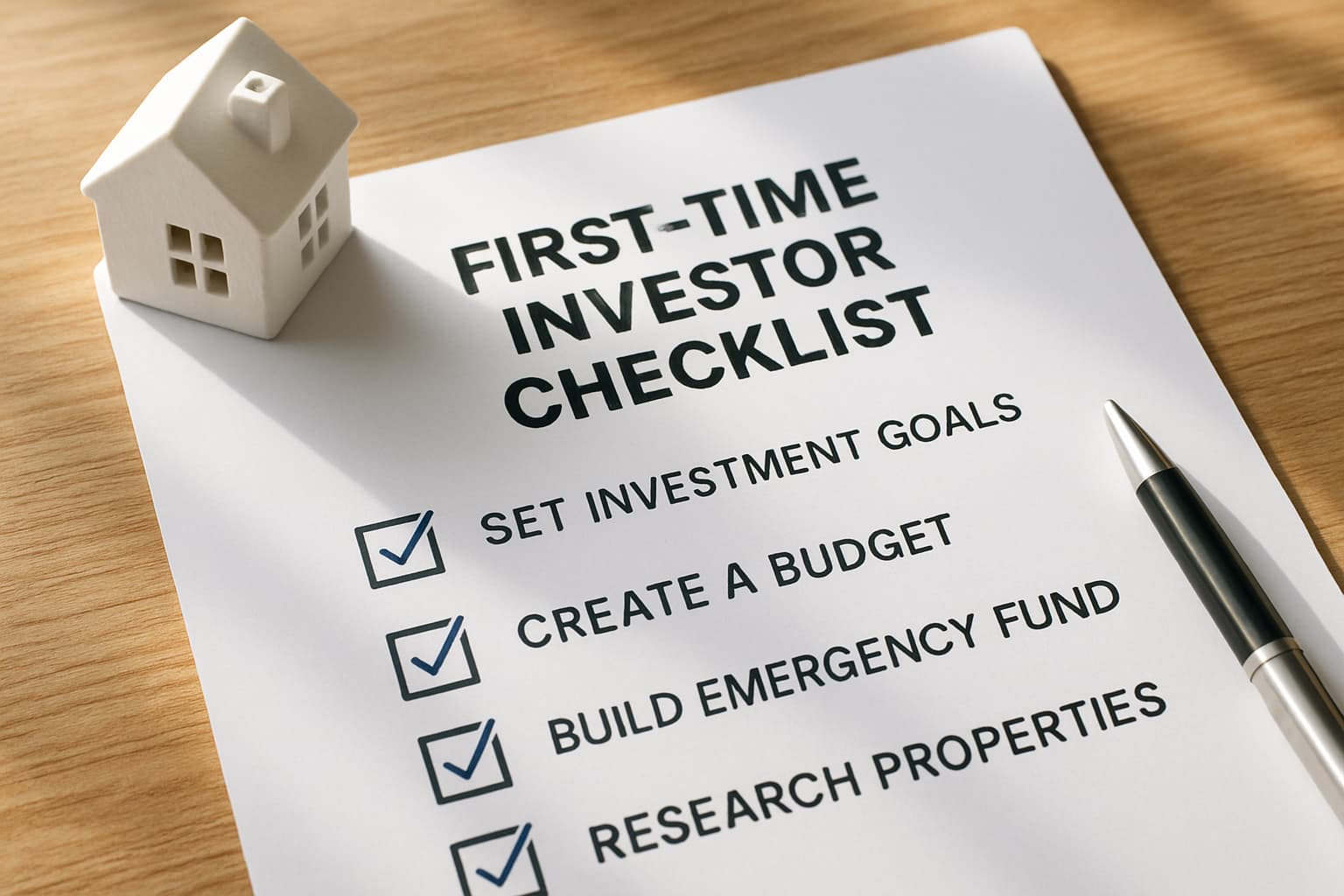
First-Time Investor Checklist
Reviewed by Lisa Park, Compliance & Operations Director
First-Time Real Estate Investor Checklist: Your Complete Getting-Started Guide
Starting your real estate investing journey can feel overwhelming. You've heard the success stories, seen the potential returns, but now you're staring at a mountain of information wondering where to begin. The difference between successful first-time investors and those who lose money often comes down to following a systematic approach.
This comprehensive checklist breaks down your path to becoming a real estate investor into manageable phases. Skip steps at your own financial peril — 78% of failed first-time investors cite inadequate preparation as their primary mistake, according to industry surveys.
What Makes a Successful First-Time Real Estate Investor
A successful first-time investor doesn't necessarily have the most money or the best market timing. They have a systematic approach, realistic expectations, and enough preparation to avoid the common pitfalls that derail beginners.
The most profitable first-time investors we finance follow a predictable pattern: they spend 3-6 months in education and preparation before making their first purchase. They understand that real estate investing is a business, not a get-rich-quick scheme.
Phase 1: Foundation & Education (Months 1-2)
1. Immerse Yourself in Real Estate Education
Before you analyze your first deal, you need to understand the language and mechanics of real estate investing. Start with these foundational steps:
- Read at least two comprehensive books on your chosen strategy (fix-and-flip, buy-and-hold, BRRRR)
- Listen to 20+ episodes of established real estate podcasts
- Join BiggerPockets and participate in forums for your target market
- Attend local real estate investor meetups (REIA groups)
Reality check: This isn't optional preparation — it's essential. The investors who skip education typically overpay for properties by 15-25% because they don't recognize red flags.
2. Choose Your Investment Strategy
You can't be everything to everyone. Pick one strategy and master it before expanding:
- Fix-and-flip: Buy distressed properties, renovate, sell quickly
- Buy-and-hold rental: Purchase properties for long-term cash flow
- BRRRR: Buy, Rehab, Rent, Refinance, Repeat for portfolio growth
- Short-term rentals: Airbnb/VRBO properties in tourist markets
Each strategy requires different financing, different market analysis, and different skill sets. Master one before attempting others.
3. Understand Your Local Market Fundamentals
Become an expert in 2-3 neighborhoods before expanding. Track these metrics weekly:
- Median home prices and trends
- Average days on market
- Rental rates by property type
- Population growth and employment data
- New construction permits and inventory levels
Phase 2: Financial Preparation (Months 2-3)
4. Optimize Your Credit Profile
Your credit score directly impacts your financing options and rates. Here's your credit optimization checklist:
- Pull all three credit reports and dispute any errors
- Pay down credit cards to below 30% utilization (ideally under 10%)
- Don't close old accounts (length of credit history matters)
- Avoid new credit inquiries for 6 months before applying for investment loans
Target score: Aim for 720+ for the best private lending rates, though many programs accept scores as low as 620.
5. Build Your Cash Reserves
Real estate investing is capital-intensive. Calculate your minimum cash needs:
- Down payment (typically 20-25% for investment properties)
- Closing costs (2-3% of purchase price)
- Rehab budget (if applicable)
- 6 months of carrying costs (mortgage, insurance, taxes, utilities)
- Personal emergency fund (separate from investment funds)
Math example: For a $200,000 fix-and-flip with $30,000 rehab:
- Down payment (25%): $50,000
- Closing costs (3%): $6,000
- Rehab budget: $30,000
- Carrying costs (6 months): $15,000
- Total needed: $101,000
6. Establish Your Business Entity
Most serious investors operate through an LLC for liability protection and tax benefits. Consult with a real estate attorney and CPA to determine the best structure for your situation and state.
7. Build Your Professional Team
Assemble your team before you need them:
- Real estate agent (investor-friendly)
- Real estate attorney
- CPA with real estate experience
- Insurance agent (landlord/flip policies)
- General contractor
- Property manager (if buy-and-hold)
Phase 3: Market Selection & Analysis (Months 3-4)
8. Conduct Data-Driven Market Analysis
Don't invest where you live just because it's convenient. Use data to identify profitable markets:
| Market Factor | Fix-and-Flip Priority | Rental Priority |
|---|---|---|
| Price appreciation | High | Medium |
| Inventory turnover | High | Low |
| Construction costs | Medium | Medium |
| Rental demand | Low | High |
| Cash flow potential | Low | High |
9. Understand the Rental Yield vs. Appreciation Trade-off
Every market falls somewhere on this spectrum:
- High-yield markets: Better cash flow, slower appreciation (Midwest/South)
- Appreciation markets: Lower yields, higher long-term returns (Coastal areas)
Example calculation: A $150,000 property renting for $1,500/month has a 12% gross rental yield. The same property price in California might only rent for $2,200/month (7.3% yield) but appreciate faster.
10. Master Deal Analysis Fundamentals
Learn to quickly evaluate potential investments using key metrics:
- Maximum Allowable Offer (MAO) for fix-and-flips
- 1% rule for rentals (monthly rent ≥ 1% of purchase price)
- Debt Service Coverage Ratio (DSCR) for financing qualification
- Cash-on-cash return for ROI analysis
DSCR calculation example: Property generating $2,400/month in rental income with $1,800/month total debt payments = 1.33 DSCR (qualifies for most DSCR loan programs).
Phase 4: Financing Preparation (Month 4)
11. Get Pre-Qualified for Investment Loans
Don't wait until you find a deal to explore financing. Understand your options:
- Hard money loans: Fast closing (7-10 days), asset-based, higher rates
- DSCR loans: Income-based qualification, 30-year terms, moderate rates
- Bridge loans: Short-term, renovation-friendly, flexible terms
- Portfolio lenders: Relationship-based, keep loans in-house
Use our hard money calculator to estimate payments and qualifying amounts.
12. Understand Private Lending Requirements
Private lenders focus on the deal, not just your personal finances. Typical requirements:
- 20-25% down payment minimum
- 680+ credit score (some programs accept 620+)
- Debt-to-income ratios matter less than asset strength
- Experience requirements vary by loan type
13. Prepare Your Loan Documentation Package
Assemble these documents before you need them:
- Personal financial statements
- Tax returns (2 years)
- Bank statements (2-3 months)
- Asset and liability schedules
- Investment property pro formas
Phase 5: Deal Execution (Months 5-6)
14. Develop Your Deal Pipeline
Don't rely on MLS listings alone. Build multiple deal sources:
- Wholesalers and bird dogs
- Direct mail campaigns
- Real estate auctions
- Off-market networking
- Distressed property databases
15. Master the Purchase Process
Investment property purchases move faster than residential transactions. Key differences:
- Shorter inspection periods (5-7 days typical)
- Cash or hard money pre-approval letters carry more weight
- Professional property analysis required for financing
- Faster closing timelines (10-15 days with private lending)
16. Build Your Contractor Network
If you're rehabbing properties, contractor selection makes or breaks profitability:
- Interview 3-5 contractors per trade
- Check references and recent work
- Get detailed written estimates
- Verify licensing and insurance
- Start with smaller projects to test reliability
Phase 6: Scaling & Growth (Ongoing)
17. Plan Your Refinance Strategy
For BRRRR investors, refinancing timing is crucial:
- Seasoning requirements: Most lenders require 6-12 months of ownership
- Appraisal considerations: Document all improvements with receipts and photos
- Cash-out limits: Typically 75-80% of appraised value
- Rate shopping: Compare portfolio lenders, credit unions, and private lenders
Use our BRRRR calculator to model your refinance scenarios.
18. Track Your Investment Performance
Measure what matters:
- Cash-on-cash return (annual cash flow ÷ cash invested)
- Total return (cash flow + appreciation + tax benefits)
- Cost per acquisition (marketing + time investment)
- Portfolio diversification by market and property type
19. Build Systems and Processes
Successful investors are systematic. Create repeatable processes for:
- Deal analysis and underwriting
- Contractor management and quality control
- Tenant screening and property management
- Financial reporting and tax preparation
20. Plan Your Portfolio Expansion
Growth without strategy leads to problems. Consider:
- Geographic diversification vs. local market expertise
- Property type diversification vs. specialization benefits
- Financing diversification across multiple lenders
- Exit strategy planning for each investment
Common First-Timer Mistakes to Avoid
Analysis Paralysis
The problem: Studying for months without taking action. The solution: Set a deadline to make your first purchase and stick to it. Perfect analysis doesn't exist.
Overpaying for Properties
The problem: Emotional decisions or inadequate comparable analysis. The solution: Always run numbers through our fix-and-flip analyzer and stick to your maximum offer calculations.
Underestimating Rehab Costs
The problem: Contractor estimates that don't include permits, surprises, or change orders. The solution: Add 20% contingency to all contractor estimates and get multiple detailed bids.
Insufficient Reserve Funds
The problem: Using all available cash for the purchase, leaving nothing for carrying costs or surprises. The solution: Maintain 6 months of property expenses in reserves, separate from your personal emergency fund.
Your Investment Financing Options
Understanding your financing options before you need them gives you negotiating power and faster execution:
| Loan Type | Best For | Typical Terms | Speed |
|---|---|---|---|
| Hard Money | Fix-and-flip, fast closing | 10-15%, 6-24 months | 7-10 days |
| DSCR Loans | Buy-and-hold rental | 7-9%, 30 years | 15-30 days |
| Bridge Loans | Transitional financing | 9-12%, 6-36 months | 10-14 days |
Each loan type serves different investment strategies and timeline requirements.
The Bottom Line
Successfully launching your real estate investing career requires systematic preparation across six key phases: education, financial preparation, market analysis, deal evaluation, financing, and execution planning. The investors who follow this 20-point checklist typically see 25-35% higher returns in their first year compared to those who jump in unprepared.
Remember that real estate investing is a marathon, not a sprint. The habits and systems you build during your first deal will determine your long-term success. Take time to build proper foundations — your future portfolio will thank you.
Ready to explore your financing options? Use our DSCR qualifier tool to see what loan programs match your investment strategy, or get pre-qualified for multiple loan types to strengthen your offer power.
Get pre-qualified in 60 seconds. No obligation.
Written by James Whitfield, Investment Analyst Reviewed by Lisa Park, Compliance Manager