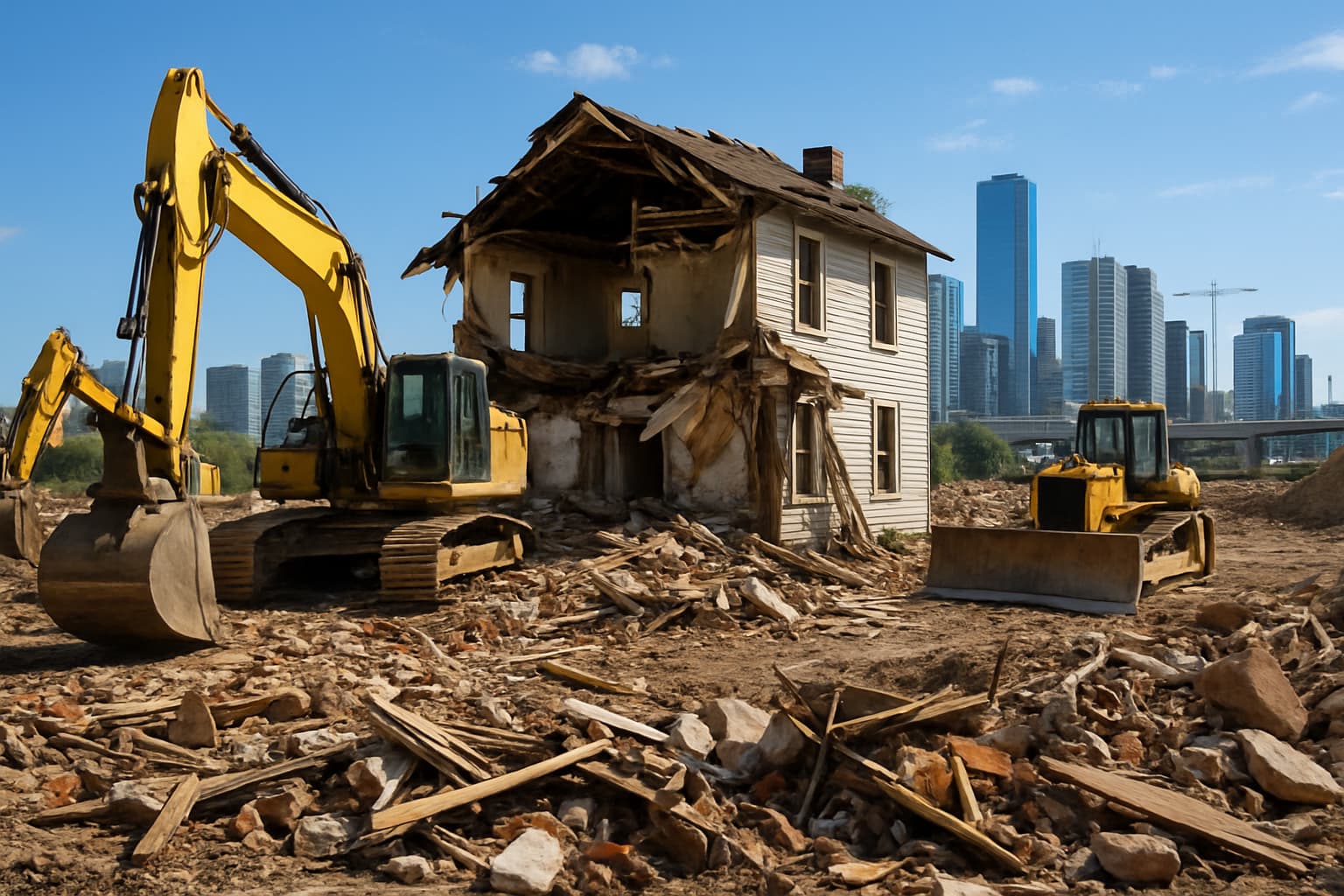
Financing Tear-Downs: When the Land Is Worth More Than the Structure
Reviewed by Lisa Park, Compliance & Operations Director
When you're walking through a property and calculating potential returns, sometimes the hardest truth to accept is this: the existing structure isn't an asset — it's a liability. The house you're looking at might be worth less than the empty lot beneath it. Welcome to the world of tear-down investing, where the real money lies in starting over completely.
Tear-down projects represent one of the most misunderstood opportunities in real estate investing. While most investors focus on cosmetic rehabs or major renovations, savvy operators recognize when destruction creates more value than construction. But here's the challenge: traditional financing wasn't built for projects where you're literally erasing the collateral.
The Economics of Strategic Demolition
When Tearing Down Makes Financial Sense
The math on tear-downs follows a simple principle: land value + new construction cost must significantly exceed acquisition price + demolition cost. But knowing when you've crossed that threshold requires understanding three key triggers.
Market-driven obsolescence occurs when neighborhood values have appreciated faster than the existing housing stock. You'll see this in gentrifying areas where $150,000 ranch homes sit on lots that could support $600,000 new construction. The differential has grown so wide that renovation can't bridge the gap.
Structural deficiencies beyond economic repair present another clear signal. Foundation failures, extensive water damage, or code violations requiring full electrical/plumbing replacement can push renovation costs past new construction numbers. When your contractor estimates $180,000 to fix what $200,000 would build new, the choice becomes obvious.
Zoning advantages for higher density or larger homes create the most profitable tear-down scenarios. Properties zoned for duplexes but containing single-family homes, or lots that allow significantly larger square footage than the existing structure, offer built-in value creation through demolition.
The Hidden Costs in Tear-Down Analysis
Most investors underestimate tear-down expenses beyond the obvious demolition cost. Permit fees for demolition and new construction typically range from $8,000 to $25,000 depending on location and project scope. Utility disconnection and reconnection adds another $3,000 to $8,000. Site preparation and debris removal can reach $15,000 to $30,000 for larger structures.
Environmental considerations create additional complexity. Properties built before 1978 require lead-safe work practices, adding 15-30% to demolition costs. Asbestos abatement can run $20,000 to $50,000 depending on the extent of contamination. These aren't optional expenses — they're regulatory requirements that can derail projects if not budgeted upfront.
The Financing Challenge: Why Traditional Lenders Say No
The Collateral Problem
Traditional fix and flip financing works because lenders can point to existing improvements as collateral. Even a distressed property has tangible value in its structure, systems, and finishes. Tear-down projects eliminate this security blanket entirely.
Hard money lenders underwrite based on after-repair value (ARV), but tear-downs create a timing gap where no improvements exist for months. Your collateral disappears on day one, leaving only raw land until construction reaches substantial completion. This makes conventional bridge loan structures nearly impossible to execute.
DSCR loans and traditional rental financing become irrelevant since there's no structure to generate rental income during the construction phase. The property produces zero cash flow while carrying full debt service, creating a qualification challenge even for experienced investors.
The Construction Loan Complexity
New construction financing operates on an entirely different model than acquisition and renovation loans. Construction lenders require detailed plans, licensed contractor relationships, and staged funding based on completion milestones. They're designed for ground-up development, not investors who need to acquire first and plan second.
Most construction lenders also require significant pre-sales or pre-leasing commitments, which don't align with fix-and-flip or BRRRR investment strategies. They're lending to developers building spec homes or custom residences, not investors creating rental properties or quick resale opportunities.
The Financing Solution: Construction-Forward Lending
Land Value Plus Construction Loans
Progressive lenders have developed hybrid products that underwrite based on land value plus construction plans rather than existing improvements. These loans combine acquisition financing with construction draws, eliminating the gap between purchase and construction funding.
The key difference lies in appraisal methodology. Instead of focusing on existing structure value, these lenders order "as-complete" appraisals based on your construction plans and comparable new construction sales. Your collateral becomes the future improved property, not the current condition.
Loan-to-cost ratios typically range from 75% to 85% of total project cost (land acquisition plus construction), with some lenders reaching 90% for experienced investors with strong track records. Interest rates run 2-4 percentage points higher than traditional hard money due to increased complexity and risk.
Phased Financing Strategies
Many investors successfully navigate tear-downs through sequential loan products. Phase one uses a bridge loan or hard money loan for acquisition and demolition. Phase two transitions to a construction loan for the build phase. Phase three refinances into permanent financing for hold strategies or facilitates sale for flip projects.
This approach requires careful timing and multiple loan applications, but it aligns each financing product with its intended purpose. Bridge loans handle the acquisition and demolition (typically 3-6 months), construction loans manage the build phase (6-12 months), and permanent financing or sale completes the cycle.
The transition points require precise coordination. Your construction lender needs confirmation that permits are approved and your contractor is ready to start before paying off the bridge loan. Any delays create expensive gap financing needs or potential project abandonment.
Combo Products: One-Stop Solutions
The most sophisticated lenders offer integrated tear-down financing that handles acquisition, demolition, and construction through a single loan structure. These products eliminate transition risk while simplifying the borrowing process.
Combo loans typically structure as interest-only construction loans with longer terms (18-24 months instead of 12) to accommodate the additional demolition and planning phases. They require more detailed upfront documentation but provide certainty throughout the entire project timeline.
Pricing reflects the additional complexity, with rates typically 1-2 percentage points higher than standard construction loans. However, the elimination of multiple loan origination fees and transition costs often makes combo products more economical for the total project.
Real-World Math: A Tear-Down Success Story
The Property Analysis
Consider a $300,000 lot purchase in a rapidly gentrifying Denver suburb. The existing 1,100-square-foot ranch home, built in 1955, has foundation settling, outdated electrical throughout, and a roof requiring complete replacement. Renovation estimates reach $220,000 for a property that would appraise at $480,000 when complete.
Compare this to tear-down economics: $25,000 demolition cost, $400,000 new construction budget for a 2,200-square-foot modern home. Total project cost equals $725,000. Comparable new construction in the neighborhood sells for $875,000 to $925,000, suggesting an ARV of $900,000.
Renovation path: $300,000 purchase + $220,000 renovation = $520,000 total cost. Potential profit: $480,000 ARV - $520,000 cost = -$40,000 loss.
Tear-down path: $300,000 purchase + $25,000 demolition + $400,000 construction = $725,000 total cost. Potential profit: $900,000 ARV - $725,000 cost = $175,000 profit.
The Financing Structure
Using a tear-down construction loan at 80% loan-to-cost, you need $145,000 down payment ($725,000 × 20%). The lender funds $580,000 through staged draws: $240,000 at closing for land acquisition, $20,000 upon demolition completion, and the remaining $320,000 through construction milestones.
Monthly interest at 12% annually equals $5,800 per month on the full loan amount once all funds are deployed. With an 18-month term, total interest cost reaches approximately $87,000 (accounting for staged funding that reduces average outstanding balance).
Final project economics: $145,000 down payment + $87,000 interest cost = $232,000 total investment. Net profit after loan payoff: $900,000 sale price - $725,000 project cost - $87,000 interest = $88,000 profit, representing a 38% return on the $232,000 invested capital.
Qualifying for Tear-Down Financing
Experience Requirements
Lenders offering tear-down financing typically require demonstrated construction or major renovation experience. They want to see at least 2-3 completed projects involving substantial structural work, new electrical/plumbing installation, or ground-up construction management.
General contractor licenses or established contractor relationships significantly strengthen applications. Lenders need confidence that you can manage complex construction timelines, navigate permit processes, and deliver projects on budget and schedule.
Financial reserves beyond the down payment are crucial. Most lenders require 6-12 months of payment reserves to cover interest during construction delays. They also want to see liquid assets equal to 10-20% of project cost for unexpected overruns or change orders.
Documentation Standards
Tear-down financing requires more extensive documentation than standard fix-and-flip loans. Detailed construction plans and specifications must be prepared by licensed architects or designers. Contractor agreements with fixed-price contracts need to be in place before loan approval.
Environmental assessments are typically mandatory given the age of structures being demolished. Phase 1 environmental reports cost $2,000 to $5,000 but are required by most lenders to identify potential contamination issues.
Municipal approvals for both demolition and new construction permits strengthen loan applications significantly. While not always required for loan approval, having permits in hand demonstrates project feasibility and reduces lender risk concerns.
Common Mistakes That Kill Tear-Down Deals
Underestimating Soft Costs
The biggest financial miscalculations occur in soft costs beyond construction and materials. Architectural and engineering fees typically run 8-12% of construction cost. Permit fees, impact fees, and utility connections add another 5-8%. These costs compound quickly on larger projects.
Carrying costs during extended timelines destroy profit margins when underestimated. Plan for 18-24 months total project timeline from acquisition to sale, not the 12 months many investors assume. Interest, insurance, and property taxes during this extended period can exceed $50,000 on higher-value projects.
Zoning and Code Compliance Issues
Setback requirements for new construction often differ from existing non-conforming structures. A house built in 1950 might sit closer to property lines than current codes allow for new construction. This can significantly reduce the buildable square footage and project profitability.
Parking and landscaping requirements for new construction frequently exceed what existed previously. Cities often require additional parking spaces, specific landscaping percentages, or stormwater management features that weren't required for the original structure.
Market Timing Risks
Tear-down projects have extended market exposure compared to quick rehabs. Your sale occurs 18-24 months after initial acquisition, creating significant market risk if conditions change. The 2008 financial crisis taught many investors that markets can shift dramatically during long construction timelines.
Comparable sales analysis becomes more complex with tear-downs since you're comparing to new construction rather than renovated properties. Make sure your ARV analysis uses truly comparable new builds, not just the highest sales in the neighborhood.
The Bottom Line
Tear-down financing opens access to some of real estate's highest-profit opportunities, but success requires matching the right financing strategy to your project specifics and experience level. The economics work when land values significantly exceed structure values, but the financing complexity demands careful planning and realistic timeline expectations.
Construction-forward lenders, phased financing strategies, and combo products each solve different aspects of the tear-down challenge. Your choice depends on project size, timeline flexibility, and access to experienced contractor relationships.
The math can be compelling — our Denver example showed $175,000 profit potential where renovation would have created losses. But remember that higher returns come with higher complexity, longer timelines, and increased capital requirements.
Calculate your numbers carefully using our construction loan calculator to model different financing scenarios, and ensure you have adequate reserves for the extended timeline and potential cost overruns that characterize tear-down projects.
Ready to explore tear-down financing for your next project? Get pre-qualified in 60 seconds. No obligation.
By James Whitfield, Investment Analyst
Reviewed by Lisa Park, Compliance Manager