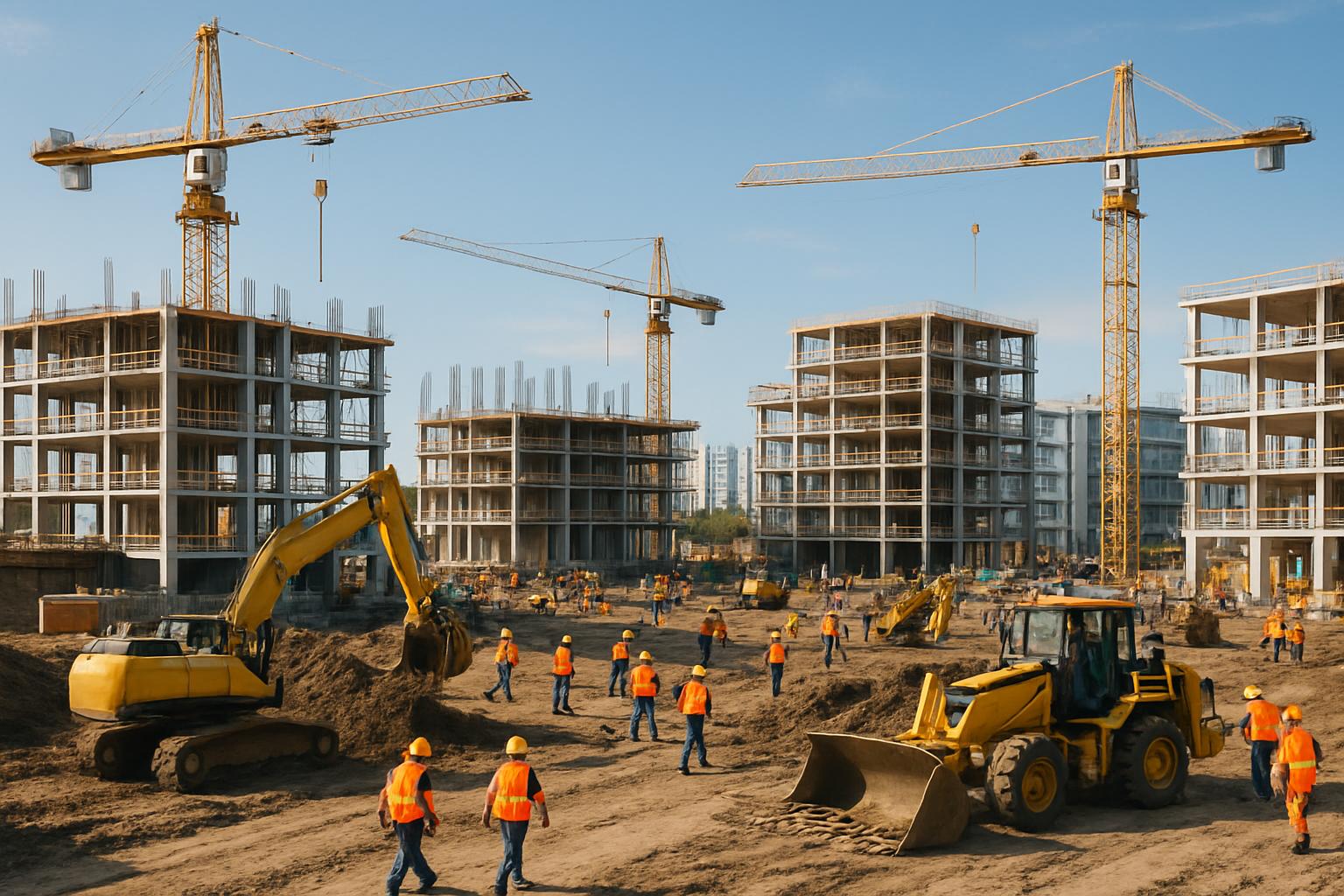
Case Study: The $3M Infill Project from Ground-Up to Sale
By Rachel Nguyen, Lending Specialist
Reviewed by Lisa Park, Compliance & Operations Director
---
title: "Case Study: The $3M Infill Project from Ground-Up to Sale"
description: "A detailed narrative case study of a $3M urban infill ground-up development — from site selection and entitlement through construction, exit, and DSCR refinance. Real numbers, real lessons."
author: "James Whitfield, Investment Analyst"
reviewed_by: "Lisa Park, Compliance Manager"
category: "strategy"
keywords: ["infill development case study", "ground up construction profit", "urban development investment", "new construction loan", "DSCR loan", "hard money lender"]
---

**Category: Strategy** | *Reviewed by Lisa Park, Compliance Manager*

Not every real estate deal is a flip. Some of the most powerful plays in an investor's portfolio are the ones you build from nothing — literally. This is the story of a **$2.95M urban infill ground-up development** that produced **three luxury townhomes**, a clean exit on two units, and a long-term income asset on the third. It's also the story of permit delays, a materials cost overrun, and the kind of problem-solving that separates experienced developers from first-timers.

Walk through this case study with real numbers, a real timeline, and real lessons you can apply to your next ground-up construction project.

---

## The Opportunity: Spotting an Undervalued Infill Lot

The subject property was a **9,200 square-foot lot** in an established inner-ring suburb of a major Southeastern metro — the kind of neighborhood where single-family bungalows from the 1940s sit two blocks from coffee shops, yoga studios, and $1.1M new construction townhomes. The lot had a derelict single-family structure on it, functionally obsolete, sitting on a corner parcel with strong street presence.

The developer — a two-person partnership with two previous townhome projects under their belts — identified the lot through a direct mail campaign targeting absentee owners of underimproved parcels within a half-mile of a specific transit corridor. The owner had inherited the property and had no interest in managing it. After negotiating directly (no broker on the seller's side), the partnership locked up the lot **under contract for $500,000**.

Comparable land sales in the area ranged from **$55 to $72 per square foot**. At $500K, this lot came in at **$54.35/SF** — just below market, with the added upside of corner lot visibility and dual street frontage that would allow for individual townhome entries, a key marketability feature.

> **Expert Tip:** Infill lot value isn't just about price per square foot. Corner lots, transit adjacency, and existing utility connections can add $50,000–$150,000 in effective value before you break ground.

---

## Entitlement: The 4-Month Rezoning Process

The lot was zoned **R-1 (single-family residential)**. The development plan called for three attached townhomes, which required rezoning to **R-3 (multi-unit residential)**. This is where the project's first significant risk materialized.

The partnership's land use attorney filed for a **Planned Unit Development (PUD) overlay** — a more flexible vehicle than straight rezoning, which allowed them to negotiate design standards (building setbacks, parking, landscaping) directly with the planning commission rather than being bound by rigid R-3 code requirements.

The process unfolded like this:

- **Month 1:** Pre-application neighborhood meeting (required by the municipality). Two neighbors objected to density; the partnership modified the site plan to add a 6-foot landscaping buffer on the north side.
- **Month 2:** Formal application submitted. Staff review and comment period.
- **Month 3:** Planning commission hearing — approved 5-2 with conditions (additional parking space, reduced building height on Unit 3 by 2 feet).
- **Month 4:** City council ratification. PUD approved.

**Total entitlement cost: $38,000** (attorney fees, application fees, traffic study, environmental survey). This came in within budget, but the timeline stretched from an anticipated **3 months to 4 months**, eating into the construction start window and ultimately contributing to a downstream delay in the permit phase.

---

## Financing: The Construction Loan Structure

With entitlements in hand, the partnership approached a private money lender for a **ground-up construction loan**. Here's the structure they secured:

| Loan Component | Detail |
|---|---|
| Total Project Budget | $2,750,000 (land + construction + soft costs) |
| Loan-to-Cost (LTC) | **80%** |
| Loan Amount | **$2,200,000** |
| Equity Injection | **$600,000** (cash + land equity) |
| Interest Rate | **10.5% (interest-only)** |
| Loan Term | **12 months** |
| Draw Structure | 6 draws based on construction milestones |
| Extension Option | 3 months at 0.5% extension fee |

The land was purchased with cash, so the equity contribution included the **$500K lot value plus $100K in additional cash reserves** held by the partnership. The lender required a minimum **20% equity stake**, a clear construction budget from a licensed GC, and a **12-month project pro forma** showing absorption timelines.

Explore how your project stacks up before you apply: use our [New Construction Loan Analyzer](/loans/new-construction/) to compare LTC options and draw structures.

---

## The Full Financial Breakdown

Here's where the math gets real. Let's walk through total project cost versus exit value, line by line.

### Total Project Cost

| Line Item | Cost |
|---|---|
| Land Acquisition | $500,000 |
| Hard Construction Costs | $2,000,000 |
| Soft Costs (plans, permits, engineering, legal) | $200,000 |
| Financing Costs (interest + origination + extension) | $250,000 |
| **Total Capital Deployed** | **$2,950,000** |

### Exit Value

| Unit | Exit Strategy | Sale/Value |
|---|---|---|
| Unit 1 | Sold | **$1,100,000** |
| Unit 2 | Sold | **$1,100,000** |
| Unit 3 | DSCR Refinance / Retained | **$1,100,000 appraised** |
| **Total Portfolio Value** | | **$3,300,000** |

### Profit Summary

- **Total Value Created: $3,300,000**
- **Total Capital Invested: $2,950,000**
- **Gross Profit (on sold units): $350,000** — after accounting for closing costs on Units 1 and 2 (~$55,000 combined in agent fees and transfer taxes)
- **Net Cash Profit: ~$295,000**
- **Unit 3 retained as income-producing asset** with ~$180,000 in equity after the DSCR refinance

> Consult your CPA regarding tax treatment of profit on the sold units versus the retained rental unit — the tax implications of a dealer vs. investor classification can materially affect your net return.

---

## Construction: 9 Months, $2M, Three Luxury Townhomes

The GC broke ground in Month 5 of the overall project timeline (accounting for the 4-month entitlement period). The construction budget was **$2,000,000 across three units**, or approximately **$667,000 per unit in hard costs**.

Each unit delivered:
- **2,100 square feet** of finished space over three floors
- Attached two-car garage with EV charging
- Rooftop terrace with city views
- High-end finishes: quartz countertops, hardwood throughout, custom tile work
- 3 bed / 3.5 bath layout

At **$317/SF in hard construction costs**, this was aggressive but achievable in the market with a local GC relationship the partnership had used on two prior projects.

### What Went Wrong: The Two Major Problems

**Problem 1: Permit Delays (45 Days Lost)**

The city's building department had a **6-week backlog** for plan review — longer than the partnership had seen on previous projects in other municipalities. The first permit pull for foundation work was delayed 45 days from the anticipated start. This had two downstream effects: it pushed the construction completion into a slower sales season, and it triggered a **3-month loan extension** (at the 0.5% extension fee, adding **$11,000** to financing costs).

The fix: the partnership hired a permit expediter for **$4,500** who navigated the comment-and-resubmission cycle. Worth every dollar.

**Problem 2: Materials Cost Overrun (~$80,000)**

Lumber and structural steel pricing spiked during the mid-construction window. The GC had locked in lumber pricing on a 90-day contract, but structural steel for the rooftop terrace framing came in **$80,000 over budget**. The partnership covered this with reserves rather than requesting a budget modification from the lender — keeping the draw schedule clean and avoiding a potential covenant issue.

Total construction cost ultimately landed at **$2,080,000** — **$80K over the original $2M budget**, offset partially by value-engineering the landscaping package ($18,000 savings) and selecting a local tile supplier over the originally specified imported stone ($22,000 savings).

**Lesson:** Always maintain a **5–10% hard cost contingency** on ground-up projects. The partnership had a 4% contingency baked into their original budget ($80K on a $2M build). That was barely enough.

Want to run contingency scenarios on your own project? The [Fix and Flip Analyzer](/tools/fix-and-flip-analyzer/) and our [BRRRR Calculator](/tools/brrrr-calculator/) can help you model cost overruns before they happen.

---

## The Exit: Two Sales and a DSCR Refinance

Construction was complete at **Month 14** from initial contract (4 months entitlement + 9 months construction + 1 month punchlist/CO). The certificate of occupancy was issued, and the units hit the market.

### Unit Sales

Units 1 and 2 were listed at **$1,125,000** each. Both went under contract within **22 days** — one at list price, one at **$1,100,000** after a brief negotiation. Combined gross sales revenue: **$2,200,000**.

At closing, the construction loan was paid off with proceeds from the two sales. After loan payoff, closing costs, and agent commissions, the partnership walked away with approximately **$295,000 in net cash**.

### Unit 3: The DSCR Refinance Play

Retaining Unit 3 was always part of the plan — this is the **long-term wealth-building layer** of the deal. With the construction loan fully retired on the other two units, the partnership moved Unit 3 into a **[DSCR loan](/loans/dscr/)** based on its rental income potential.

Here's the DSCR math:

- **Appraised Value: $1,100,000**
- **DSCR Loan at 70% LTV: $770,000**
- **Estimated Market Rent: $5,800/month**
- **Annual Gross Rent: $69,600**
- **PITIA (principal, interest, taxes, insurance, HOA): ~$5,100/month** (estimated at current market rates — verify with a lender at time of application)
- **DSCR: $5,800 / $5,100 = 1.14x** — qualifies for most DSCR programs (minimum is typically 1.0x–1.25x depending on lender)

The $770,000 refinance proceeds were used to replenish cash reserves for the next project. Unit 3 now sits in the portfolio as a **cash-flowing luxury rental** with roughly **$330,000 in equity** and a professional property manager handling operations.

Use the [DSCR Qualifier](/tools/dscr-qualifier/) to check whether your retained unit qualifies before you commit to the hold strategy.

---

## Timeline Summary

| Phase | Duration | Key Events |
|---|---|---|
| Site identification & contract | Month 0–1 | Direct mail, negotiation, contract execution |
| Due diligence & entitlement | Month 1–5 | PUD application, planning commission, approval |
| Financing & loan close | Month 5–6 | Construction loan commitment, equity injection |
| Construction | Month 6–15 | 9-month build + 1-month extension due to permits |
| Sales & refinance | Month 15–17 | Two units sold, Unit 3 DSCR refi |
| **Total project duration** | **~17 months** | From contract to full exit |

---

## Common Mistakes in Urban Infill Ground-Up Projects

This case study surfaced several mistakes that trip up developers at every experience level. Don't repeat them:

- **Underestimating entitlement timelines.** Plan for the process to take **50% longer** than the municipality's stated review period. Buffer this into your construction loan term from day one.
- **Thin contingency budgets.** On ground-up construction, **10% hard cost contingency** is the minimum you should carry. This partnership ran 4% and got lucky it was enough.
- **Not modeling the extension option.** Extension fees are real costs. The 3-month extension here added **$11,000** to the financing tab. Model it in your pro forma as an expected expense, not a worst case.
- **Skipping permit expediters.** A $4,500 expediter recovered weeks of delay. That's a 10:1 ROI when you consider the cost of carrying an idle construction loan.
- **Ignoring the hold strategy until the end.** The DSCR play on Unit 3 was baked into the underwriting from day one. If you decide mid-project to hold a unit, you may not have the right loan structure or equity position to make it work cleanly.

---

## The Bottom Line

This **$2.95M infill development** delivered **$295,000 in net cash profit** on the two sold units — about a **10% cash-on-cash return** on capital deployed — plus a **luxury rental asset with $330,000 in equity** and positive cash flow. Total value created: **$350,000 gross / $295,000 net plus a retained income asset**.

That's not a home run, but it's a very solid base hit. Ground-up urban infill isn't the highest-margin play in real estate on a percentage basis — but it builds significant equity, creates durable assets, and positions you for repeat development in markets where you've established relationships and local knowledge.

The keys that made this deal work:
- **Below-market land acquisition** through direct outreach
- **Experienced legal and construction teams** with local relationships
- **A construction loan structure** that included realistic timeline buffers
- **Pre-planned DSCR exit** on the retained unit

If you're evaluating a ground-up project right now, the first step is knowing your numbers before you commit. Use our [Hard Money Calculator](/tools/hard-money-calculator/) to model your financing costs, and visit our [New Construction Loan page](/loans/new-construction/) to understand what lenders actually look for in a ground-up deal.

**Ready to take your infill project from lot to certificate of occupancy?** [Get pre-qualified in 60 seconds. No obligation.](/apply/)